Every year, thousands of Kenyans living in the UK, USA, Canada, Australia, and the Gulf states decide to build a home back home — a house for retirement, a family base, or simply proof that the years abroad meant something. And every year, some of those same diaspora Kenyans lose millions of shillings to fake title deeds, vanishing contractors, and “supervisors” who stop sending updates the moment the money lands.
It doesn’t have to be that way. Building a house in Kenya from abroad is entirely achievable in 2026 — Kenya’s land registry is now largely digital, power of attorney processes are well established, and a professional construction partner can manage the entire project on your behalf. This guide walks you through exactly how to do it safely, step by step.
Why More Diaspora Kenyans Are Building Now
Land in high-growth corridors around Nairobi and other major towns continues to appreciate steadily, and for many in the diaspora, building rather than buying finished property offers more control over design, budget, and long-term value. A home built to your own specification, supervised properly, is also simply more satisfying to come back to — whether you plan to retire in it, rent it out, or hand it to family.
The challenge has never been the desire to build. It’s the distance.
Step 1: Verify the Land Before You Spend a Shilling
This is the single most important step, and the one most diaspora buyers get wrong by rushing.
Before committing any money:
- Do an official land search through Kenya’s digital land registry (Ardhisasa) or through eCitizen, to confirm the registered owner and check for any caveats, disputes, or encumbrances on the parcel.
- Engage a Law Society of Kenya-registered advocate to review the title deed, sale agreement, and any Land Control Board consent required — never rely solely on the seller’s paperwork.
- Confirm the title matches the ground reality. Survey maps and boundaries should be physically verified by someone you trust on the ground, not just taken on the seller’s word.
- Be alert to common fraud patterns: land sold using forged documents, the same plot sold to multiple buyers, or a seller pressuring you to “act fast because someone else is interested.” Genuine sellers do not rush buyers.
If anyone offers to “handle everything” and asks you to simply send money without showing you documents at each stage, treat that as a red flag and walk away.
Step 2: Understand Power of Attorney — and Its Limits
You do not need to be physically present in Kenya to buy land or build a house, but you will need a way to sign documents, collect approvals, and manage payments remotely. This is usually done through a notarised Power of Attorney (PoA).
A few important points:
- A PoA should be specific and time-limited, tied to the named parcel and transaction — not a broad, open-ended power over your affairs.
- Clearly define what your attorney can and cannot do: sign documents, collect paperwork, make payments, or receive title. Exclude borrowing, resale, or any powers you don’t explicitly intend to grant.
- Never grant PoA to the seller or their agent, no matter how convenient it seems. The person holding your PoA should represent your interests only.
- Confirm with your advocate exactly which steps genuinely require a PoA in your specific transaction — not every purchase needs the same instrument.
Step 3: Bring In the Right Construction Partner Early
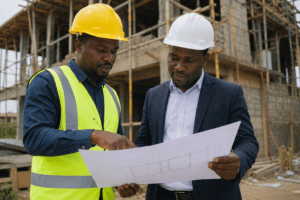
This is where many diaspora projects go wrong. Buyers often secure the land first and only start looking for a contractor once ground is already broken — by which point there’s no professional oversight on design, budgeting, or sequencing.
The right order is:
- Architectural drawings and approvals — before any construction contract is signed.
- A detailed Bill of Quantities (BOQ) — so you know exactly what you’re paying for at every stage, not vague lump-sum estimates.
- A registered, NCA-compliant contractor — verify National Construction Authority registration before signing anything.
At Jowach Construction Limited, this is exactly how we structure diaspora projects: drawings and BOQ first, transparent milestone-based payments second, and construction only once you’ve approved both. You are never asked to send money against a verbal estimate.
Step 4: Structure Payments Around Verified Milestones
Money sent without a structured payment plan is the most common way diaspora clients lose funds — not to outright fraud, but to slow, unaccountable “cost creep.”
Protect yourself by insisting on:
- A BOQ-linked payment schedule, where each release is tied to a specific, verifiable stage of construction (foundation, walling, roofing, finishes).
- Photo and video documentation at each stage before the next payment is released.
- An independent site visit or valuation at key milestones, rather than relying solely on the contractor’s own reporting.
This isn’t about distrust — it’s standard, professional project management, and any reputable construction company will welcome it because it protects them too.
Step 5: Set Up Remote Supervision That Actually Works
You cannot be on-site every week, but you can still have real visibility into your project’s progress. A good diaspora construction partner will provide:
- Regular photo and video updates from the site
- Scheduled video calls at key construction milestones
- A single point of contact who understands you’re managing this from a different time zone
- Honest, prompt communication when issues arise — not silence followed by a surprise bill
At Jowach Construction, our diaspora clients receive structured progress updates throughout the build, so you always know exactly where your money and your house stand — whether you’re in Nairobi, London, Minneapolis, or Dubai.
What Does It Cost to Build from the Diaspora in 2026?
Construction costs in Kenya in 2026 generally fall into three bands:
- Standard finishes: roughly KES 35,000 – 50,000 per square metre
- Mid-range finishes: roughly KES 50,000 – 80,000 per square metre
- High-end/luxury finishes: KES 80,000 – 130,000+ per square metre
For a typical 3-bedroom home of 120–150 square metres, this puts most diaspora projects in the KES 5 million to KES 12 million range, depending on finish level and location — before land cost. Getting an accurate BOQ from your contractor at the outset is the only reliable way to know your real number; generic online estimates are a starting point, not a budget.
Common Mistakes Diaspora Builders Make (And How to Avoid Them)
- Sending money before verifying land ownership. Always search the title first.
- Skipping the architect and BOQ stage. Going straight to a contractor without approved drawings leads to scope confusion and cost overruns.
- Granting broad, unrestricted Power of Attorney. Keep it specific and time-bound.
- Relying on family members instead of professionals for site supervision. Well-meaning relatives are not a substitute for a qualified site supervisor or quantity surveyor.
- Paying lump sums instead of milestone-based amounts. This removes your only real financial checkpoint during construction.
Why Diaspora Clients Choose Jowach Construction
Jowach Construction Limited is a leading construction company in Kenya, trusted by clients across the country and abroad to deliver residential and commercial projects with transparency and professionalism from foundation to handover. For diaspora clients specifically, we provide:
- Detailed, itemised Bills of Quantities before construction begins
- NCA-compliant, professionally supervised construction
- Milestone-based payment structures with photo and video verification
- Regular, honest communication tailored to your time zone
- A single dedicated contact throughout your project
You don’t need to be in Kenya to build a home you’ll be proud of. You need a partner who treats your project the way you would if you were standing on the site yourself.
Frequently Asked Questions
Can I build a house in Kenya without traveling back at all? Yes. With a properly structured Power of Attorney, a trustworthy construction partner, and regular remote reporting, many diaspora clients complete their entire build without a single trip home, though visiting at key milestones is always recommended if possible.
How do I know my land title is genuine before I build? Conduct an official land search through Kenya’s digital land registry and have an independent, Law Society-registered advocate review all documents. Never rely solely on documents provided by the seller.
How long does it take to build a standard 3-bedroom house in Kenya? Depending on size, finish level, and weather conditions, most standard 3-bedroom homes take between 8 and 14 months from groundbreaking to handover.
Do I need to pay contractors in full upfront? No, and you shouldn’t. Payments should always be structured around verified construction milestones, not paid as a single lump sum in advance.
What’s the first professional I should hire — an architect or a contractor? An architect (or the design team at your construction company) should always come first, to produce approved drawings and a BOQ before any contractor begins physical work.
Ready to build your dream home in Kenya, wherever you are in the world? Contact Jowach Construction Limited today for a transparent, professionally managed diaspora building experience.
📞 Phone: +254 704 264302 📧 Email: Info@jowachconstuction.co.ke 🌐 Website: jowachconstruction.co.ke