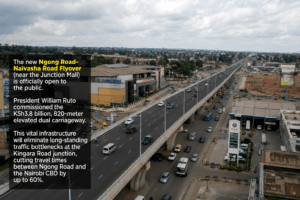
If you’ve ever sat in traffic at Junction Mall trying to get past Dagoretti Corner, you know exactly why this project mattered. On June 29, 2026, President William Ruto commissioned the Ngong Road–Naivasha Road Flyover near Junction Mall, opening a long-awaited 820-metre, four-lane structure designed to clear one of Nairobi’s most persistent traffic bottlenecks. Examiner
For anyone who has done business, bought land, or built property along that corridor, this is more than just a traffic story. It’s a signal of where Nairobi’s growth is headed next.
What Was Actually Built
The flyover separates the main traffic flow from local turning movements at the busy junction where Ngong Road, Naivasha Road and Kingara Road meet. Ground-level lanes now serve the immediate local area while the elevated section carries through-traffic past the junction entirely, with pedestrian walkways, cycling lanes, drainage and lighting built into the design. Mjengo Hub
The project was funded through a concessional loan of Sh3.58 billion from the Spanish Corporate International Fund, with construction handled by a Spanish firm that also delivered the Thika Superhighway flyover. Work began in August the previous year, and by June 2026 the structure was ready for commissioning. The StarKenyans.co.ke
The numbers on this build are genuinely striking:
| Detail | Figure |
|---|---|
| Length | 820 metres |
| Cost | Ksh 3.8 billion |
| Lanes | Four-lane elevated dual carriageway |
| Cost per centimetre | Roughly Ksh 46,341 |
| Junctions addressed | Ngong Road, Naivasha Road, Kingara Road |
| Expected travel time reduction | Up to 60% |
Why This Matters Beyond Just Traffic
President Ruto framed the project in clearly economic terms, noting that every hour lost in traffic represents forfeited productivity, delayed income, and diminished opportunity. That’s not just political language, it’s a fact that anyone running a business, managing deliveries, or commuting through Dagoretti Corner has felt directly for years. Examiner
What’s already starting to happen on the ground backs this up. Residents in the area say the transformation of the Ngong Road corridor has turned what was once a congested transport point into an area attracting more businesses, visitors and economic activity. One resident described how the improved infrastructure has opened up the neighbourhood, with the smoother traffic flow already visible as the area prepares for AFCON 2027. The Eastleigh Voice
This is a pattern we’ve seen before in Nairobi. Wherever major road infrastructure goes in, land values follow, rental demand shifts, and new commercial activity moves in behind it. Thika Road, Southern Bypass, and the Nairobi Expressway corridor all followed the same trajectory. Dagoretti Corner and the wider Ngong Road axis are now positioned for the same kind of shift.
This Flyover Isn’t Standing Alone
The Ngong Road flyover is part of a much bigger push to modernise Nairobi’s transport network ahead of the city hosting the 2027 Africa Cup of Nations. Ruto used the commissioning to outline a wider pipeline of Nairobi infrastructure currently underway, including a 3 billion shilling viaduct near Upper Hill that’s roughly 60 percent complete, a 1.6 billion shilling upgrade to State House Road, and access roads worth 3.9 billion shillings serving Talanta Sports City. Examiner
On top of that, the government is implementing an Intelligent Transport System covering more than 210 signalised junctions across Nairobi at a cost of Ksh 45 billion, aimed at improving traffic flow through coordinated, real-time management, alongside maintenance of 729 kilometres of roads across the capital. People Daily
A separate 2 billion shilling drainage initiative has also launched alongside the flyover, aimed at preparing the city for anticipated El Niño rains, with works already underway across all 85 of Nairobi’s wards. Examiner
Put together, this tells you Nairobi’s western corridor, from Dagoretti through Ngong Road toward Karen and Ngong Town, is entering a period of sustained infrastructure investment. That’s exactly the kind of signal property developers and landowners should be paying attention to.
What This Means If You’re Building or Investing Near This Corridor
At Jowach Construction, we look at projects like this through a practical lens: infrastructure investment today shapes construction demand tomorrow. Here’s what property owners along the Ngong Road, Naivasha Road, and Dagoretti Corner axis should be thinking about:
Land values in the area are likely to rise. Reduced congestion and better access typically drive up demand for both residential and commercial plots along improved corridors.
Rental demand may shift toward the area. Easier commutes into the CBD and improved access to Talanta Stadium make properties along this route more attractive to tenants who previously avoided the area due to traffic.
Commercial opportunities are opening up. As foot traffic and vehicle movement increase around Junction Mall and Dagoretti Corner, retail and mixed-use developments in the vicinity stand to benefit.
Now is the time to plan, not wait. Infrastructure-driven growth tends to move fast once it starts. Property owners who develop early in a corridor like this typically see stronger returns than those who wait until the area is already built up.
Building Along Nairobi’s Growth Corridors
Whether you own land near this corridor already or you’re considering an investment in the wider Ngong Road, Karen, or Dagoretti area, the fundamentals of a solid build don’t change: proper structural planning, transparent costing, and quality workmanship that holds up as the area develops around it.
At Jowach Construction, we help clients plan and execute residential and commercial projects across Nairobi’s growing corridors, from apartment blocks and bedsitter developments to standalone homes, with the same attention to detail whether you’re building today or positioning for the growth still to come.
Frequently Asked Questions
1. Where exactly is the new flyover located?
The flyover sits at the junction of Ngong Road, Naivasha Road, and Kingara Road, near Junction Mall in Dagoretti Corner, Nairobi.
2. How much did the flyover cost?
The project cost Ksh 3.8 billion, funded through a concessional loan from Spain’s Corporate International Fund.
3. How much will travel time actually improve?
The government projects travel time reductions of up to 60 percent along the corridor, primarily by separating through-traffic from local turning movements.
4. Is this the only major road project happening in Nairobi right now?
No. It’s part of a wider pipeline that includes the Upper Hill viaduct, State House Road upgrade, Talanta Sports City access roads, and a citywide Intelligent Transport System covering over 210 junctions.
5. Should I consider building or buying property near this corridor now?
Areas that receive major infrastructure upgrades like this one often see rising land values and rental demand in the following years. If you’re considering a project in this area, it’s worth getting a professional assessment sooner rather than later.
Planning a Project Along Nairobi’s Growth Corridors?
Whether you’re looking to build near Dagoretti Corner, Ngong Road, or anywhere else in Nairobi’s expanding infrastructure map, Jowach Construction can help you plan a project that’s built to last and positioned to benefit from the growth around it.
📞 Call/WhatsApp: +254 704 264302
📧 Email: Info@jowachconstuction.co.ke
🌐 Website: jowachconstruction.co.ke
Contact us today for a free consultation on your next construction project.