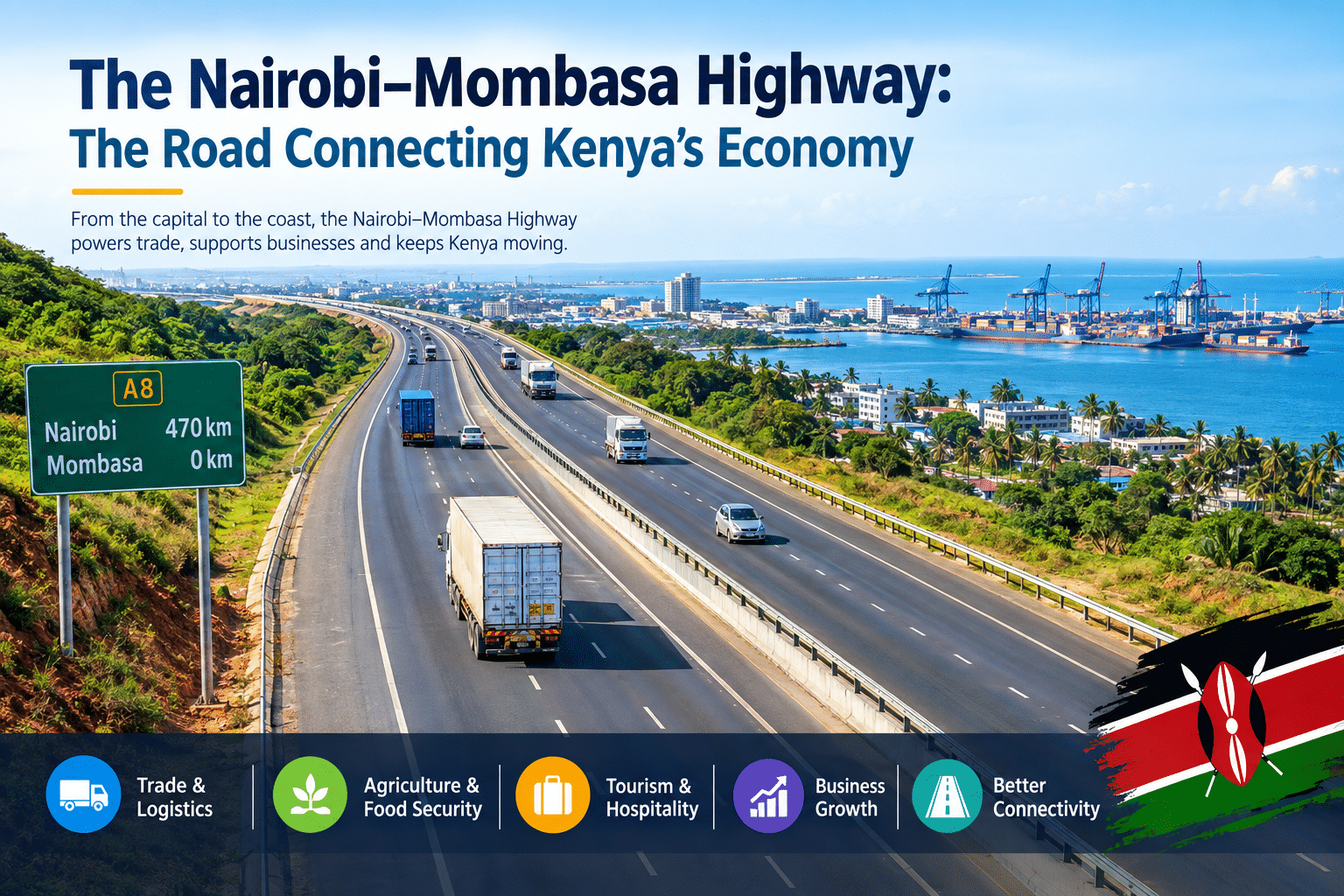
The Nairobi–Mombasa Highway is one of Kenya’s most important roads. Stretching between the capital city of Nairobi and the coastal city of Mombasa, the corridor carries passengers, agricultural products, manufactured goods, fuel and heavy freight every day.
The route is also closely connected to Kenya’s wider regional trade network because Mombasa is home to the Port of Mombasa, a major gateway for goods entering and leaving Kenya and serving markets across East Africa.
As traffic and freight volumes continue to grow, Kenya is planning further improvements to the corridor, including a proposed expansion of the existing highway into a wider, access-controlled tolled road.
What Is the Nairobi–Mombasa Highway?
The Nairobi–Mombasa Highway is commonly associated with the A8 corridor linking Nairobi and Mombasa.
The road forms part of the Northern Corridor and the wider Trans-African Highway network. It provides an important connection between the Port of Mombasa, Nairobi and inland markets.
For businesses, the road is particularly important because trucks use the corridor to transport goods between the coast, Nairobi and neighbouring countries.
The Kenya National Highways Authority lists the Nairobi–Mombasa corridor among its major highway projects and planned improvements.
Why Is the Nairobi–Mombasa Road So Important?
The importance of the highway goes beyond connecting two Kenyan cities.
Mombasa is a major entry and exit point for international cargo, while Nairobi is the country’s largest commercial and administrative centre. The highway therefore links two important economic centres.
Goods arriving through the Port of Mombasa can be transported by road toward Nairobi and other parts of Kenya and the wider region.
The corridor also supports tourism by connecting Nairobi with Kenya’s coastal destinations.
The Highway and the Port of Mombasa
One of the biggest reasons the Nairobi–Mombasa route is strategically important is its connection to the Port of Mombasa.
The road provides a land connection between the port and inland destinations.
Heavy trucks transporting containers and other cargo regularly use the corridor, making efficient road infrastructure important for logistics companies, manufacturers, importers and exporters.
The wider Northern Corridor also connects Kenya with land-linked markets in East and Central Africa. Government transport programmes have identified improved regional connectivity as an important part of Kenya’s role as a transport and logistics hub.
The Future Nairobi–Mombasa Expressway
Kenya is considering a major upgrade of the existing Nairobi–Mombasa highway.
The proposed Nairobi–Mombasa Expressway would expand the approximately 461-kilometre A8 corridor from the existing two-lane configuration to a minimum four-lane access-controlled tolled road.
The government’s 2026 PPP status report describes the project as a priority PPP and says procurement of a transaction adviser was underway, with the request for proposals published in March 2026.
Kenya’s investment project catalogue also describes the proposed project as a four-lane tolled expressway and identifies the corridor as an important route for freight movement between Mombasa Port, Nairobi and regional markets.
What Would the Highway Expansion Change?
The proposed expansion is intended to increase the capacity of the existing corridor.
A larger road could provide additional space for passenger vehicles and heavy commercial traffic.
The project concept includes access control and supporting facilities such as truck parking and logistics infrastructure.
These improvements are intended to address congestion and improve the movement of goods and people along the corridor.
Will the Nairobi–Mombasa Expressway Have Tolls?
The proposed upgraded highway is planned as a tolled road.
Under the proposed arrangement, users would contribute towards the cost of providing and maintaining the infrastructure.
However, motorists should distinguish between the proposed Nairobi–Mombasa Expressway and the existing Nairobi Expressway in Nairobi. They are separate projects.
The Nairobi Expressway runs for about 27.1 kilometres between the Mlolongo area and James Gichuru Road, while the proposed Nairobi–Mombasa Expressway concerns the much longer intercity A8 corridor.
How Could the Project Benefit Businesses?
Transport costs are an important part of doing business.
For companies moving goods between Mombasa and Nairobi, delays can increase fuel consumption, driver costs and delivery times.
A higher-capacity highway could help improve the movement of commercial vehicles.
Potential areas of economic impact include:
- Freight and logistics
- Manufacturing
- Agriculture
- Wholesale and retail trade
- Tourism
- Construction
- Warehousing
- Real estate
- Transport services
Improved connectivity can also encourage businesses to establish operations along major transport corridors.
The Road and Kenya’s Agricultural Sector
Agriculture is another sector that depends heavily on reliable transport.
Farmers and agricultural businesses need roads to move products from production areas to markets.
The Nairobi–Mombasa corridor can provide an important route for agricultural products moving toward major urban markets and the coast.
Better transport infrastructure can reduce delays and improve the reliability of supply chains.
Tourism Along the Nairobi–Mombasa Corridor
The highway also supports Kenya’s tourism industry.
Nairobi is an important starting point for visitors travelling to different parts of the country, while Mombasa and the Kenyan coast attract visitors for beaches, cultural experiences and other tourism activities.
A reliable road connection between the two cities supports movement by tourists, tour operators, hotels and other businesses.
Road Safety and Traffic Management
The growth in traffic on major highways creates pressure on road infrastructure.
Heavy trucks, buses, private vehicles and motorcycles may all use sections of the corridor, creating different traffic patterns.
A modern access-controlled highway can incorporate infrastructure designed to separate traffic movements, manage access points and improve road safety.
The proposed Nairobi–Mombasa project is intended to incorporate design solutions that improve capacity while maintaining local connectivity.
The Mombasa Southern Bypass
The Nairobi–Mombasa transport corridor is also being supported by other road infrastructure around Mombasa.
The Mombasa Southern Bypass, also known as the Dongo Kundu Bypass, was completed in 2024.
According to Kenya’s PPP project status report, the bypass provides an alternative to the congested Likoni Ferry crossing and improves connectivity between the Northern Corridor and the southern corridor toward Tanzania.
This type of supporting infrastructure is important because improving one section of a transport network is more effective when connected roads can also handle increasing traffic.
Nairobi–Mombasa Road vs Railway Transport
Road transport is not the only way goods and passengers move between Nairobi and Mombasa.
Kenya’s Standard Gauge Railway provides another major transport connection between the two cities.
The government has been working to increase the role of rail in moving passengers and freight, with the SGR forming part of a broader multimodal transport system.
In March 2026, the government launched construction of the Naivasha–Kisumu–Malaba SGR extension, which is intended to strengthen regional connectivity beyond the existing Mombasa–Naivasha railway.
The development of both road and rail infrastructure means Kenya is building a broader transport network rather than relying on a single mode of transportation.
Challenges Facing the Nairobi–Mombasa Highway
Large highway projects also face challenges.
Construction Disruption
Expanding an existing road can affect motorists while construction is underway.
Temporary diversions, reduced speeds and changes to traffic arrangements may be necessary.
Financing
A project covering hundreds of kilometres requires substantial investment.
The proposed Nairobi–Mombasa Expressway is being considered through a Public-Private Partnership framework, meaning financing and project structuring are important parts of the development process.
Land and Local Connectivity
Highway expansion can require careful management of land acquisition and access to communities and businesses located along the existing route.
An access-controlled road also needs suitable interchanges and connections so that local traffic can continue reaching surrounding areas.
What Is the Current Status of the Nairobi–Mombasa Expressway?
As of April 2026, Kenya’s PPP Directorate classified the Nairobi–Mombasa Expressway among projects in early-stage preparations.
The government report states that the project involves upgrading the 461-kilometre A8 corridor to a minimum four-lane access-controlled tolled road and that procurement of a transaction adviser was underway.
This means motorists should distinguish between a proposed future expressway expansion and infrastructure that is already operational.
Project timelines and designs can change as feasibility, financing, procurement and approvals progress.
What Does the Future Hold for the Nairobi–Mombasa Corridor?
The Nairobi–Mombasa corridor is likely to remain one of Kenya’s most important transport routes.
Population growth, urbanisation, trade and regional commerce continue to create demand for efficient transportation.
The future transport system is also likely to involve several modes working together, including roads, railways and port infrastructure.
For Kenya, the goal is not simply to make journeys between Nairobi and Mombasa easier. Efficient transport is closely connected to the movement of goods, access to markets and the country’s position within East African trade networks.
Frequently Asked Questions
How long is the Nairobi–Mombasa Highway?
The proposed Nairobi–Mombasa Expressway project covers approximately 461 kilometres of the A8 corridor according to current government project documents.
Is the Nairobi–Mombasa Expressway already complete?
No. The proposed full corridor expansion is still in the project development and preparation stages. The government’s April 2026 PPP report placed it among projects in early-stage preparations.
Will the Nairobi–Mombasa Expressway be tolled?
The proposed project is designed as an access-controlled tolled road.
Why is the Nairobi–Mombasa road important?
It connects Nairobi with Mombasa and the Port of Mombasa and supports the movement of passengers, freight and goods to inland and regional markets.
What is the Northern Corridor?
The Northern Corridor is a major regional transport route associated with the Port of Mombasa and connections into Kenya and neighbouring East and Central African markets.
Is there a railway between Nairobi and Mombasa?
Yes. Kenya’s Standard Gauge Railway provides passenger and freight services between Nairobi and Mombasa and forms part of the country’s wider transport network.
Conclusion
The Nairobi–Mombasa Highway is much more than a road between two Kenyan cities. It is a major economic link connecting the country’s capital, the Port of Mombasa, businesses, communities and regional markets.
As Kenya’s economy and regional trade continue to grow, the demand for reliable transport infrastructure will remain high.
The proposed expansion of the A8 corridor into a wider access-controlled tolled highway represents one part of Kenya’s long-term plans to increase road capacity and improve freight and passenger movement.
At the same time, railway projects and supporting roads such as the Mombasa Southern Bypass are contributing to a broader transport network.
For motorists, businesses, investors and travellers, developments along the Nairobi–Mombasa corridor will therefore remain important to watch as Kenya continues to upgrade its transport infrastructure.